How Long Does It Take To Learn French ( A Guide for English Speakers)
How Long Does It Take To Learn French ( A Guide for English Speakers)
Learning French involves a unique timeline that depends on individual goals and study routines. Factors such as the number of study hours, immersion level, and focus on vocabulary or grammar influence the pace of progress. Whether the aim is basic communication or professional fluency, the journey is shaped by the chosen approach, be it classroom instruction, self-study, or intensive courses.
Clear milestones and realistic expectations help learners navigate the path to fluency with confidence. Transcript’s AI study tool provides personalized schedules, tracks progress, and offers targeted exercises to refine the learning timeline []().
Summary
- Benchmarks vary widely, with estimates of roughly 600 to 750 hours to reach proficiency, the FSI citing about 23 to 24 weeks for intensive study, and most learners landing somewhere between 6 and 24 months, depending on intensity and goals.
- In 12-week course observations, learners who already spoke a Romance language moved through grammar and vocabulary blocks with far less friction, showing that prior language background materially shortens early timelines.
- Study frequency matters more than marathon sessions, with 20 minutes of focused daily speaking and listening outperforming a single two-hour session per week for retention and real-world recall.
- Allocate practice by function to get measurable gains: aim for about 40 percent active speaking, 30 percent listening in real contexts, 20 percent focused grammar correction, and 10 percent spaced review.
- Start speaking early and schedule corrective practice, since focused 8-week speaking blocks with three coached 20-minute sessions per week produced roughly a threefold increase in spontaneous speaking length and notable drops in hesitation.
- Measure concrete milestones to track real progress, for example, 30 seconds of unscripted speech without long pauses, correct comprehension of a one-minute native clip, and the ability to repair a misunderstanding, with two corrective repetitions logged within 48 hours.
- This is where Transcript's AI study tool fits in, by providing instant pronunciation and grammar feedback, adaptive prompts, and simulated conversation practice to focus study time on persistent errors.
What Determines How Fast You Can Learn French?
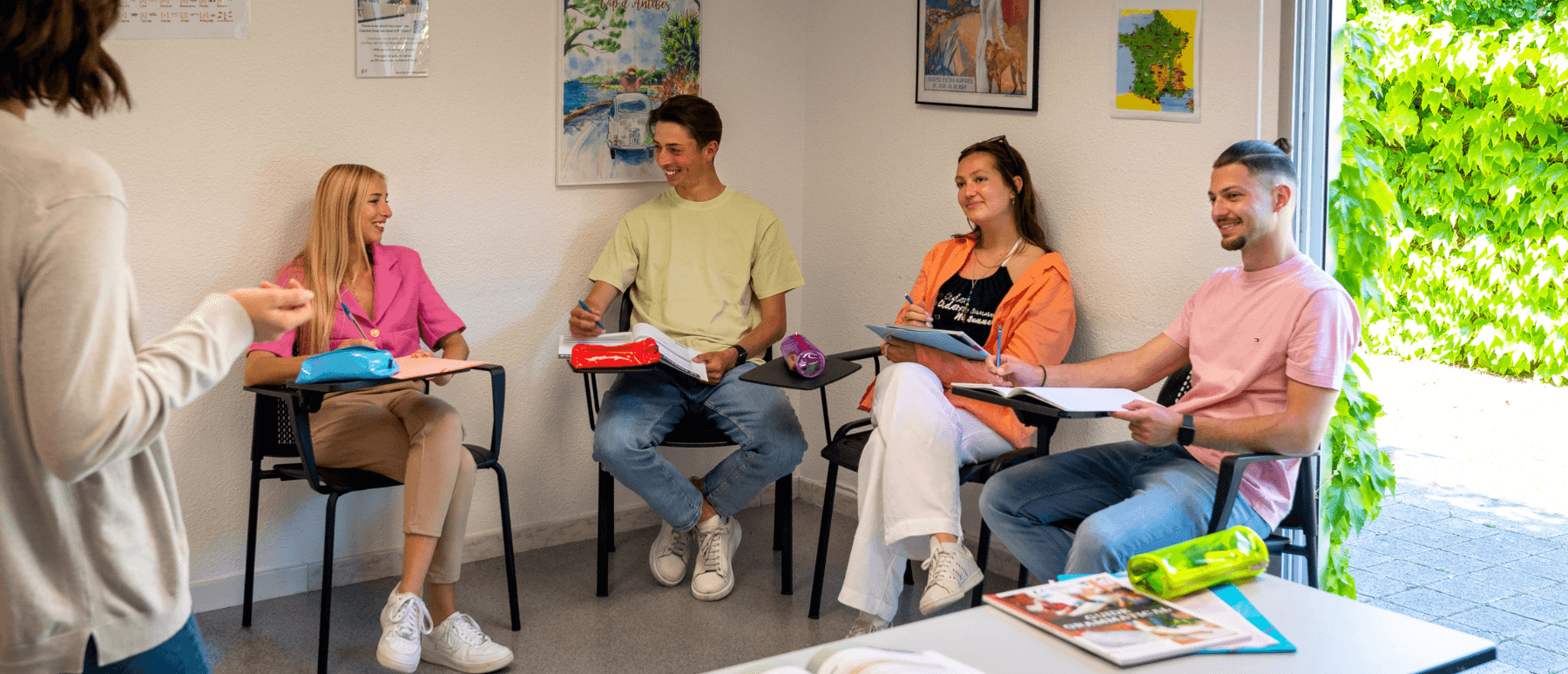
You can get good at French in just a few months or take a year or more. It all depends on how you start and what you do each week. While there are benchmarks to help you, they are only reference points.It takes about 600-750 hours of study to reach a skilled level in French, according to French As You Like It (2023). Also, the Foreign Service Institute (FSI) estimates that it takes learners about 23-24 weeks to learn French (FSI, 2023). These numbers show different levels of study intensity, not promises for every learner.
How does my language background change the timeline?
When working with adult learners in 12-week courses, we noticed a clear pattern: learners who already spoke a Romance language progressed through grammar and vocabulary challenges with much less difficulty. In contrast, English-only speakers needed more practice with sounds and sentence rhythm. This difference isn't about intelligence; it has to do with linguistic transfer.Shared roots give shortcuts for ideas like gender, verb patterns, and thousands of cognates. This changes weeks of memorization into just a few focused review sessions. To aid in this process, our AI study tool can help streamline your learning and enhance your review sessions.
How much does study frequency matter for speed?
A consistent pattern emerges: short daily practice works better than big study sessions every once in a while. Just twenty minutes of focused speaking and listening each day helps you remember things and recall them in real life better than a two-hour session once a week.Daily practice helps strengthen your ability to remember, leading to less time spent relearning and more time using the language in conversations.
Which learning methods actually accelerate progress?
If a learner is in a French-speaking environment, they will improve fastest by soaking up the language's rhythm, shortcuts, and everyday expressions naturally, without needing to study hard. Structured classes and tutors offer accuracy and corrections that help to get rid of bad habits early on. While apps are helpful for building vocabulary, they often hit a limit unless balanced with real conversations. Self-study can work well, especially when it has specific speaking goals and outside feedback; if not, progress can slow down and become disconnected.To assist with this, our AI study tool helps learners identify key speaking opportunities and provides personalized feedback.
Why Does Speaking Early Make Such a Difference?
The failure point is usually avoidance. Avoiding speaking because pronunciation feels hard only delays fluency. When learners start speaking in low-stakes settings right away, they shorten the time between understanding and using the language. That practice creates feedback loops: you notice mispronunciations, you fix them, and you keep going.Being comfortable with messy speech is the single biggest boost I recommend. Our AI study tool helps you practice pronunciation in real-time, reinforcing your confidence and fluency.
How do motivation and personal learning style change the clock?
If your goal is travel phrases, you will focus on different skills than someone who wants workplace fluency. Each path shortens different parts of the journey. Visual learners understand grammar faster with charts and captions, while auditory learners gain from podcasts and repeat-back drills.Hands-on learners need conversation practice to strengthen their skills. Matching the method to your learning style is not optional; it is essential for efficiency. Our AI study tool can help you find the best resources tailored to your unique learning style.
What strategies help overcome common learner habits?
Most learners start with habits they know that work at first, but these methods often struggle as things get more complicated. A common strategy is to use the same app and take some classes now and then, which makes it easy to keep up.While this way helps with basic learning, trying to have real conversations brings up big challenges. Feedback and specific corrections become really important; if not, pronunciation errors can get stuck, vocabulary gaps can grow, and practice time can get messy instead of helpful.
Tools like Transcript's AI study tool give you adaptive practice with instantaneous corrections, making sure you have personalized pacing and conversation simulations.This method changes haphazard studying into clear progress, effectively lessening the gap between the time you spend learning and your ability to use French.
What support structures actually shorten the path?
After coaching learners through competency-based modules, I found that the biggest time-savers were simple: consistent corrective feedback, scheduled conversation partners, and a daily audio habit. High-quality feedback stops learners from making the same mistakes for months. Scheduled speaking sessions help keep track of progress in your calendar, making sure practice does not slip away.Additionally, utilizing our AI study tool can enhance your learning experience by providing personalized feedback and targeted practice. By putting these supports together with focused grammar micro-lessons, students can turn hours of unfocused study into real conversation skills.
What factors contribute to stalled progress?
It’s frustrating when effort feels steady, but progress does not. The reason usually comes from a mix of background, frequency, method, and feedback. This combination decides whether those benchmark hours turn into usable French.
How do individual choices affect learning outcomes?
That familiar timetable looks neat until individual choices change each hour into either progress or just staying busy. This understanding makes what comes next much more surprising.
Related Reading
- How to Learn Calculus Fast
- How Long Does It Take To Learn Coding
- How Long Does It Take to Learn Calculus
- How To Study French
- How To Study For Organic Chemistry
- How To Study Chemistry
- How To Study For A History Test
- How To Study For Anatomy
- How To Study Computer Science
Realistic Timelines for Learning French (Beginner to Fluent)

Progress can be made on a regular schedule if study time is seen as targeted practice instead of just passive exposure.By focusing on speaking with helpful feedback, learners will turn hours into clear speaking milestones faster than with simple review alone.
How can you turn hours into measurable speaking gains? Allocate practice by function, not by app. Aim for about 40 percent active speaking and production, 30 percent listening in authentic contexts, 20 percent focused grammar or form correction, and 10 percent spaced review of weak items.This distribution helps focus most effort on the hardest skill, speaking, where improvements add up effectively. For students aiming to enhance their practice, Transcript provides an excellent AI study tool that offers personalized feedback and structured learning plans.
Why do comprehension and speaking pull apart for so many learners?
Why do comprehension and speaking often diverge for so many learners? This pattern shows up in both self-study and classroom settings. Learners usually build passive vocabulary and comprehension skills, but often avoid speaking because they worry about mispronunciations and making mistakes can be costly. The hidden reason for this issue is weak and timely correction, which allows mistakes to become habits.To illustrate, think of learning as fixing a road: you can lay asphalt quickly, but if the support beams are crooked, the whole surface will buckle under the weight. Immediate and specific correction fixes the beams before the surface cracks. Our AI study tool can assist with timely feedback on pronunciation and grammar, helping learners feel more confident when speaking.
What does the familiar approach cost you?
What does the familiar approach cost you? Most learners manage their practice by mixing an app, taking classes sometimes, and having unguided conversations because it is comfortable and easy to start. This method may work at first, but as one aims for reliable speech, scattered practice lets errors stick around, and progress slows.Solutions like Transcript’s AI study tool provide instant feedback on pronunciation and grammar, simulated conversation practice with adaptable prompts, and personalized scheduling that focuses on ongoing errors. This approach turns practice time into measurable spoken output instead of just passive hours.
What does a high-value 30-minute session look like?
A high-value 30-minute session starts with 5 minutes of quickly going over the words that were difficult yesterday. This is followed by 12 minutes of shadowing and practicing speaking using a short clip. Next, spend 8 minutes on a targeted grammar exercise that relates to the speaking task. Finally, finish with 5 minutes of spaced recall or reviewing mistakes.If you only have 10 minutes, shorten the session to 6 minutes of speaking and 4 minutes of reviewing errors. This method helps you practice a lot while making sure you correct mistakes right away, which gives you the best results in a short time. Our AI study tool helps streamline this process with personalized exercises.
How should you set realistic expectations?
To set realistic expectations, consider that most learners reach fluency in 6–24 months with 600–750 hours of study. Another reference explains the same effort level like this: it takes approximately 600-750 hours to reach a proficient level in French. Our AI study tool can help you maximize your learning efficiency during this time.
When targeted speaking is added, results accelerate?
When focused speaking is added, results get better. After running targeted 8-week speaking blocks, where learners took part in three coached 20-minute sessions each week, the measured spontaneous speaking length in unscripted tasks increased about three times. Also, hesitation clearly decreased in recorded role-plays.This kind of change happens because scheduled, corrective practice pushes the brain to connect forms to fluent output, instead of just letting them stay as passive recognition. For those interested, our AI study tool can enhance structured learning experiences even further.
How does Transcript help with learning?
Transcript brings AI-powered study tools right to students' fingertips. This resource helps them handle difficult coursework more easily.As an AI study tool, Transcript mixes instant scan-and-solve features with a smart digital notebook and an AI chat that gives step-by-step explanations. Users can scan a problem and get detailed solutions, receiving answers for free with Transcript.
What small practice habit can erase progress?
This simple adjustment can be effective, but one small practice habit may quietly erase weeks of progress.
Related Reading
- How To Study For A Biology Test
- How To Study Marine Biology
- Best Way To Learn Coding
- How To Study For Biology
- How To Study For History
- How To Study For Biology In College
- How To Learn Chemistry On Your Own
- How To Pass Social Studies GED Test
- How To Speak French For Beginners
- How To Get Better At Chemistry
- How To Study For Economics
8 Tips to Learn French Faster as an English Speaker

To speed up your usable French, focus on getting past the most complex challenge first. For most English speakers, this challenge is understanding fast, casual speech and changing that understanding into speaking right away.Using specific mini-practice sessions, careful error tracking, and short, planned speaking exercises can turn weeks of unclear practice into clear progress, as explained in the NETC manual. Our AI study tool helps you with targeted practice sessions to improve your listening and speaking skills effectively.
Over 200 million people speak French across five continents, according to French Fluency Blog. French is the second most widely learned foreign language after English, with 120 million students currently learning it.
How do I retrain my ear for fast, slang-heavy French?
Begin with a 3-stage listening loop using 20 to 60-second clips of real speech. First, read the transcript and find three problem areas. Next, listen at regular speed while repeating those parts. Finally, record yourself saying the same parts until your rhythm matches.Using short clips is important because doing this repeatedly helps you understand patterns better. Think of each clip as a small experiment: change one thing, see if understanding gets better, and then try again. This method makes you focus on reductions, liaison, and intonation instead of tuning out during quicker speech. Additionally, consider how our AI study tool can assist you in refining your listening skills for even better proficiency.
What do I do when native speakers never slow down?
This is where retrieval practice is better than just passive exposure. To improve your conversation skills, make six short response templates that you will actually use in real conversations. Practice them in three ways: scripted production, scrambled-word ordering, and free recall after a one-minute distraction. The limit of time, along with the stress of getting things wrong, speeds up fluency.Your brain learns to focus on usable forms instead of just being theoretically correct. It can be tiring when classrooms reward perfect grammar, but real life asks for immediate meaning. Training under time pressure helps close that gap. Additionally, using our tools can enhance your learning experience by providing you with tailored practice sessions.
How do you turn passive content into active training?
Convert one passive item each day into four active tasks: transcribe a 30-second excerpt, create two cloze deletions, shadow the clip, and write a three-sentence reaction in the same style.Treat casual social media videos as practice for prosody and slang, not just for fun.This method is common among successful adult learners; they stop reaching a plateau when they stop just consuming French and start to produce it using real input, along with quick correction loops.Our AI study tool can help you achieve this by providing tailored exercises designed to enhance your learning process.
What should you measure to know you are actually improving?
Replace vague goals like "study more" with three concrete benchmarks: 30 seconds of unscripted speech without long pauses, correct comprehension of a one-minute native clip at normal speed, and the ability to repair misunderstandings in a live exchange.
Log each attempt, note the recurring errors, and enforce two corrective repetitions within 48 hours.This small discipline can transform scattered practice into cumulative momentum; for personalized assistance, consider how our AI study tool can support your learning journey.
How does tuning relate to language improvement?
Improvement can be compared to tuning a radio. Bad adjustments give you some signal, but careful and repeatable changes bring back full audio clarity.This work needs both technical skills and human intuition. When you track even the smallest fixes, progress speeds up quickly. If you’re looking for a systematic approach, consider how our AI study tool enhances your learning experience.
What role does Transcript play in learning?
Transcript brings AI-powered study tools directly to students' fingertips. This helps them tackle complex coursework more efficiently. As an AI study tool, Transcript combines instant scan-and-solve capabilities with an intelligent notebook and step-by-step chat explanations.This approach ensures that every mistake becomes a clear, repeatable lesson. To assist with maximizing learning, our AI study tools offer features that enhance understanding and retention.
What simple step do most learners skip?
Most learners often overlook a single, simple step that can make their learning process very easy to repeat.Our AI study tool enhances retention and simplifies studying.
Get Answers for Free Today with Transcript
You want usable conversational French on a schedule that fits your life, not one-size-fits-all timelines. Focus on steady speaking practice and tools that change weekly effort into measurable milestones.I recommend trying Transcript, an AI study tool that turns short daily sessions into focused, corrected practice. This way, you spend fewer unfocused hours and really hear real improvement in your speaking; our AI study tool helps streamline your learning.