
20 College Math Problems (With Worked Examples and Answers)
In the world of Best Math Learning Apps, clear solutions change how students handle homework and exam prep. Have you ever sat up late, stuck on an integral or a tricky proof, and wished for a worked example?
This guide gives 20 college math problems with worked examples and answers across calculus, algebra, linear algebra, and differential equations, so you can practice with step-by-step solutions, sample problems, and answer keys.
Transcript AI study tool then guides you through each solution with plain explanations, solution walkthroughs, instant feedback, and extra practice problems to help you build confidence and improve test performance.
Summary
- Worked examples across 20 college-level problems convert abstract concepts into repeatable procedures, teaching method selection rather than rote formula recall. Taking higher-level math is linked to academic persistence, with students who take such courses 30% more likely to graduate within four years.
- A strong math background also offers economic returns, with graduates earning, on average, $10,000 more per year than peers without it.
- Short, daily practice delivers measurable gains, as 85% of students who practice math daily see improvement within a month.
- Structure practice like interval training, using one short block of 15 to 25 minutes and one longer block of 45 to 60 minutes, or roughly three focused hours per week for surgical progress.
- Deliberate error correction and digital feedback accelerate learning: deliberately correcting an error pattern three times turns it into a reliable skill, and students using math apps improve skills about 30% faster.
- AI study tool Transcript addresses this by providing instant scan-and-solve, stepwise explanations, and a searchable error log to shorten the practice-feedback loop.
Why Practicing Math in College is Important

Practicing college-level math problems trains you to think in ordered, testable steps so you can solve new problems reliably, not just reproduce formulas. You build a habit of breaking a problem into parts, testing hypotheses, and choosing the right tool for each step, which shows up as faster, more confident work on exams and in the lab.
Why do drilling problems sharpen reasoning so reliably?
When we turn abstract ideas into repeated, structured practice, the brain learns a procedure and the judgment that goes with it. Solving a sequence of worked examples builds mental patterns for spotting which technique applies, and that pattern recognition is what converts slow, anxious trial-and-error into deliberate strategy. This pattern appears across introductory courses and adult learners: many stop practicing because math feels abstract and irrelevant, and that loss of context strips away the very practice that would teach them how to reason through unfamiliar tasks.
Which cognitive skills actually improve with problem practice?
You strengthen decomposition, estimation, and conditional thinking. Decomposition means splitting a complex statement into manageable lemmas; estimation trains you to sanity-check answers; conditional thinking teaches you to choose between methods based on constraints like time, required rigor, or available data. These are the same skills employers ask for when they want analytical problem-solving, and practicing worked solutions turns a vague ability into measurable performance.
How does this translate into measurable outcomes?
[Students who take higher-level math courses in college are 30% more likely to graduate within four years. That 2025 Education Week finding links the discipline of mathematical practice to persistence in school, showing that this is not just brain training; it shifts academic momentum. Graduates with a strong math background earn, on average $10,000 more annually than those without. Education Week reported that in 2025, the payoff for disciplined practice is clear, both economic and intellectual.
What breaks in the standard approach to learning math?
Most students rely on passive exposure, reading notes, or watching a solution once because it feels efficient. That approach works until you face a novel problem on an exam or a project, at which point it fails because recognition does not equal reproduction under pressure. As complexity increases, scattered notes and one-off examples create a brittle understanding, so time pressure and unfamiliar contexts reveal gaps in reasoning rather than skill.
What alternative actually closes that gap?
Most learners stick with passive study because it is familiar and low-friction. That familiarity has a hidden cost; it keeps knowledge surface-level and exam performance inconsistent. Platforms like problem-and-solution libraries with fully worked answers and step-by-step explanations change that dynamic; they preserve the context of each method, highlight common pitfalls, and provide repeatable practice so students move from spotting patterns to applying them reliably, improving speed and accuracy on tests.
How do worked answers teach judgment, not just technique?
When a worked solution shows why one substitution fails and another succeeds, you learn the decision process, not just the move. I see this repeatedly: students who study stepwise explanations stop guessing and start choosing, and that reduces exam panic. Framing each problem around curriculum alignment and likely exam formats makes practice directly transferable to coursework and assessments, so every solved problem becomes deliberate rehearsal rather than a one-off demonstration.
A short test of the idea: think of a proof as building scaffolding, not a finished wall. Practicing many small scaffold steps teaches you how to scaffold quickly when the question asks for an unfamiliar wall.
That simple insight changes everything about how you approach the next set of problems.
Related Reading
- Why Am I So Bad at Math
- What Does PEMDAS Stand for in Math
- How to Make Math Fun
- Funny Math Problems
- How To Study For Maths Exam
20 College Math Problems (With Worked Examples and Answers)

We present twenty college-level problems across algebra, calculus, trigonometry, probability, and linear algebra, each with a clear, stepwise solution so you learn the reasoning, not just the result. These problems are chosen to mirror curriculum-aligned examples from 20 College Math Problems (With Worked Examples and Answers) and the Accuplacer Next-Generation Sample Questions, ensuring practice that maps to exam formats.
Algebra and Functions (Problems 1–5)
Problem 1: Factor and solve
Solve x^3 − 6x^2 + 11x − 6 = 0.
Step-by-step:
- Try integer roots using Rational Root Theorem, test x = 1: 1 − 6 + 11 − 6 = 0, so x = 1 is a root.
- Divide polynomial by (x − 1) using synthetic division to get x^2 − 5x + 6.
- Factor x^2 − 5x + 6 = (x − 2)(x − 3).
- So roots are x = 1, 2, 3.
Final answer: x ∈ {1, 2, 3}.
Problem 2: Rational equation
Solve (2x + 3)/(x − 1) = (x + 5)/(x + 1). State excluded values.
Step-by-step:
- Exclude x = 1 and x = −1.
- Cross-multiply: (2x + 3)(x + 1) = (x + 5)(x − 1).
- Expand: 2x^2 + 2x + 3x + 3 = x^2 − x + 5x − 5.
- Simplify: 2x^2 + 5x + 3 = x^2 + 4x − 5.
- Subtract right side: x^2 + x + 8 = 0.
- Compute discriminant: Δ = 1 − 32 = −31, so no real solutions.
Final answer: No real solution (complex roots only); x ≠ 1, −1.
Problem 3: Polynomial division
Divide 4x^3 − x^2 + 2x − 5 by x − 1 and give the quotient and remainder.
Step-by-step:
- Synthetic division with root 1: coefficients 4, −1, 2, −5.
- Bring down 4. Multiply 1·4 = 4; add to −1 gives 3.
- Multiply 1·3 = 3; add to 2 gives 5.
- Multiply 1·5 = 5; add to −5 gives 0.
- Quotient is 4x^2 + 3x + 5, remainder 0.
Final answer: Quotient 4x^2 + 3x + 5, remainder 0, so x − 1 is a factor.
Problem 4: System with quadratic
Solve y = x^2 − 4 and x + y = 2.
Step-by-step:
- Substitute y into the second equation: x + (x^2 − 4) = 2.
- Rearrange: x^2 + x − 6 = 0.
- Factor: (x + 3)(x − 2) = 0 so x = −3 or x = 2.
- Find y: for x = −3, y = 9 − 4 = 5. For x = 2, y = 4 − 4 = 0.
Final answers: (x, y) = (−3, 5) and (2, 0).
Problem 5: Inverse function
Find f^{-1}(x) for f(x) = (3x − 2)/(x + 1), domain x ≠ −1.
Step-by-step:
1. Set y = (3x − 2)/(x + 1).
2. Swap x and y then solve for y: x = (3y − 2)/(y + 1).
3. Multiply: x(y + 1) = 3y − 2 → xy + x = 3y − 2.
4. Solve y terms: xy − 3y = −x − 2 → y(x − 3) = −(x + 2).
5. So y = −(x + 2)/(x − 3). Domain excludes x = 3.
Final answer: f^{-1}(x) = −(x + 2)/(x − 3), x ≠ 3.
Calculus (Problems 6–10)
Problem 6: Limit with trig
Compute lim_{x→0} (sin 3x − 3x)/(x^3).
Step-by-step:
- Use Taylor series: sin 3x = 3x − (27 x^3)/6 + O(x^5) = 3x − (9/2) x^3 + higher terms.
- Subtract 3x, numerator ≈ −(9/2) x^3.
- Divide by x^3 gives −9/2.
Final answer: −9/2.
Problem 7: Indefinite integral
Evaluate ∫ (2x)/(x^2 + 1) dx.
Step-by-step:
- Let u = x^2 + 1, then du = 2x dx.
- Integral becomes ∫ du/u = ln|u| + C.
- Substitute back: ln(x^2 + 1) + C.
Final answer: ln(x^2 + 1) + C.
Problem 8: Improper integral
Evaluate ∫_{0}^{∞} e^{-2x} dx.
Step-by-step:
- Compute antiderivative: ∫ e^{-2x} dx = −(1/2) e^{-2x}.
- Evaluate from 0 to ∞: limit as b→∞ of [−(1/2) e^{-2b}] − [−(1/2) e^{0}].
- First term goes to 0, second term is −(−1/2) = 1/2.
Final answer: 1/2.
Problem 9: Critical points and classification
Find and classify critical points of f(x) = x^3 − 3x + 1.
Step-by-step:
- Compute derivative: f'(x) = 3x^2 − 3 = 3(x^2 − 1).
- Set f'(x) = 0 → x^2 − 1 = 0 → x = ±1.
- Compute second derivative: f''(x) = 6x.
- f''(1) = 6 > 0 so x = 1 is local minimum. f''(−1) = −6 < 0 so x = −1 is local maximum.
- Evaluate function values if needed: f(1) = −1, f(−1) = 3.
Final answers: local max at (−1, 3), local min at (1, −1).
Problem 10: Taylor approximation
Give the Taylor polynomial up to x^2 for e^{2x} centered at 0.
Step-by-step:
- e^{2x} expansion: sum_{n=0}^{∞} (2x)^n / n!.
- Truncate after x^2: 1 + 2x + (2x)^2/2 = 1 + 2x + 2x^2.
- State remainder is O(x^3).
Final answer: 1 + 2x + 2x^2 + O(x^3).
Status quo, friction, and a better bridge
Most students compile scattered PDFs and one-off solution videos because that feels quick and familiar. That approach works at first, but as problem types multiply, missing steps and inconsistent notation create confusion and cost study time while confidence erodes. Platforms like AI study tool centralize worked solutions, scan-and-solve, and stepwise explanations, letting students maintain consistent notation and recover context instantly, reducing wasted time and preserving learning momentum.
Trigonometry and Geometry (Problems 11–13)
Problem 11: Law of cosines
In triangle ABC, sides a = 7, b = 10, and angle C = 120 degrees. Find side c opposite angle C.
Step-by-step:
- Law of cosines: c^2 = a^2 + b^2 − 2ab cos C.
- cos 120° = −1/2, so c^2 = 7^2 + 10^2 − 2·7·10·(−1/2).
- Compute: 49 + 100 + 70 = 219.
- c = √219.
Final answer: c = √219.
Problem 12: Area from coordinates
Find the area of the triangle with vertices (0, 0), (4, 0), (1, 3).
Step-by-step:
- Use the shoelace formula: A = 1/2 |x1y2 + x2y3 + x3y1 − (y1x2 + y2x3 + y3x1)|.
- Plug in: 1/2 |0·0 + 4·3 + 1·0 − (0·4 + 0·1 + 3·0)| = 1/2 |12| = 6.
Final answer: Area = 6 square units.
Problem 13: Half-angle with quadrant
Given cos θ = −3/5 with θ in quadrant II, find sin(θ/2).
Step-by-step:
- Use half-angle: sin(θ/2) = ±√((1 − cos θ)/2).
- Since θ in QII, θ/2 is in QI (because 90° < θ < 180° implies 45° < θ/2 < 90°), so sin(θ/2) > 0.
- Compute (1 − (−3/5))/2 = (1 + 3/5)/2 = (8/5)/2 = 4/5.
- Take positive root: sin(θ/2) = √(4/5) = 2/√5 = (2√5)/5 after rationalizing.
Final answer: sin(θ/2) = (2√5)/5.
Probability and Statistics (Problems 14–17)
Problem 14: Binomial probability
A biased coin has a probability of heads p = 0.6. What is P(exactly 3 heads) in 5 tosses?
Step-by-step:
- Use binomial formula: P(X = k) = C(n, k) p^k (1 − p)^{n−k}.
- Here n = 5, k = 3: C(5, 3) = 10.
- Compute: 10 · (0.6)^3 · (0.4)^2 = 10 · 0.216 · 0.16 = 10 · 0.03456 = 0.3456.
Final answer: 0.3456.
Problem 15: Expected value and variance
Random variable X takes values 0, 2, 5 with probabilities 0.2, 0.5, 0.3, respectively. Find E[X] and Var(X).
Step-by-step:
- E[X] = 0·0.2 + 2·0.5 + 5·0.3 = 0 + 1 + 1.5 = 2.5.
- Compute E[X^2] = 0^2·0.2 + 4·0.5 + 25·0.3 = 0 + 2 + 7.5 = 9.5.
- Var(X) = E[X^2] − (E[X])^2 = 9.5 − 6.25 = 3.25.
Final answers: E[X] = 2.5, Var(X) = 3.25.
Problem 16: Bayes’ rule
A test for a disease has 95% sensitivity and 90% specificity. Disease prevalence is 2%. What is the probability that a person has the disease given a positive test?
Step-by-step:
- Let D = disease, T+ = positive. We want P(D|T+) = P(T+|D)P(D) / [P(T+|D)P(D) + P(T+|not D)P(not D)].
- P(T+|D) = 0.95, P(D) = 0.02. P(T+|not D) = 1 − specificity = 0.10, P(not D) = 0.98.
- Numerator = 0.95·0.02 = 0.019. Denominator = 0.019 + 0.10·0.98 = 0.019 + 0.098 = 0.117.
- Compute ratio: 0.019 / 0.117 ≈ 0.1624.
Final answer: ≈ 16.24%.
Problem 17: Poisson probability
Events occur at an average rate λ = 2 per hour. What is the probability of zero events in a two-hour interval?
Step-by-step:
- For Poisson, the mean over two hours is λ' = 2·2 = 4.
- P(X = 0) = e^{−λ'} λ'^0 / 0! = e^{−4}.
- e^{−4} ≈ 0.0183.
Final answer: ≈ 0.0183.
Linear Algebra and Vectors (Problems 18–20)
Problem 18: Determinant and invertibility
Matrix A = [[2, 3], [4, 7]]. Determine det(A) and whether A is invertible.
Step-by-step:
- det(A) = 2·7 − 3·4 = 14 − 12 = 2.
- Since det ≠ 0, A is invertible.
- Inverse formula for 2×2: A^{-1} = (1/det) [[7, −3], [−4, 2]] = (1/2)[[7, −3], [−4, 2]].
Final answers: det = 2, invertible, A^{-1} = (1/2)[[7, −3], [−4, 2]].
Problem 19: Eigenvalues
Find eigenvalues of B = [[4, 1], [2, 3]].
Step-by-step:
- Characteristic polynomial: det(B − λI) = (4 − λ)(3 − λ) − 2·1 = (12 − 4λ − 3λ + λ^2) − 2 = λ^2 − 7λ + 10.
- Solve λ^2 − 7λ + 10 = 0 → (λ − 5)(λ − 2) = 0.
- Eigenvalues: λ = 5 and λ = 2.
Final answers: λ1 = 5, λ2 = 2.
Problem 20: Projection of a vector
Given u = (1, 2, 2) and v = (2, 0, 1), find the projection of u onto v.
Step-by-step:
- proj_v u = [(u·v)/(v·v)] v.
- Compute u·v = 1·2 + 2·0 + 2·1 = 4.
- Compute v·v = 2^2 + 0^2 + 1^2 = 5.
- Scalar = 4/5. So projection = (4/5) (2, 0, 1) = (8/5, 0, 4/5).
Final answer: proj_v u = (8/5, 0, 4/5).
Practical note from our work with students over a semester: when problems are paired with short, consistent stepwise explanations, learners stop guessing and start choosing the proper method faster; the pattern shows up in improved timing during timed practice and fewer careless algebraic errors. Think of method selection like using a labeled tool chest, where clear steps tell you which tool fits the fast fix versus the proof you must build.
Transcript brings AI-powered study tools directly to students' fingertips, helping them tackle complex coursework more efficiently. Our platform features an instant scan-and-solve, an intelligent digital notebook, and an AI chat system that provides step-by-step explanations, making Transcript an AI study tool students can use to get detailed solutions and learn faster.
That solution set looks finished, but the real test is how you turn one solved problem into a repeatable technique under exam pressure.
Related Reading
- How To Understand Maths Easily
- How To Get Better At Math In High School?
- How To Study For A Math Test
- How To Study For A Math Quiz
- How to Learn Math Fast
- Best Way to Learn Math
Tips to Master Math Faster in College
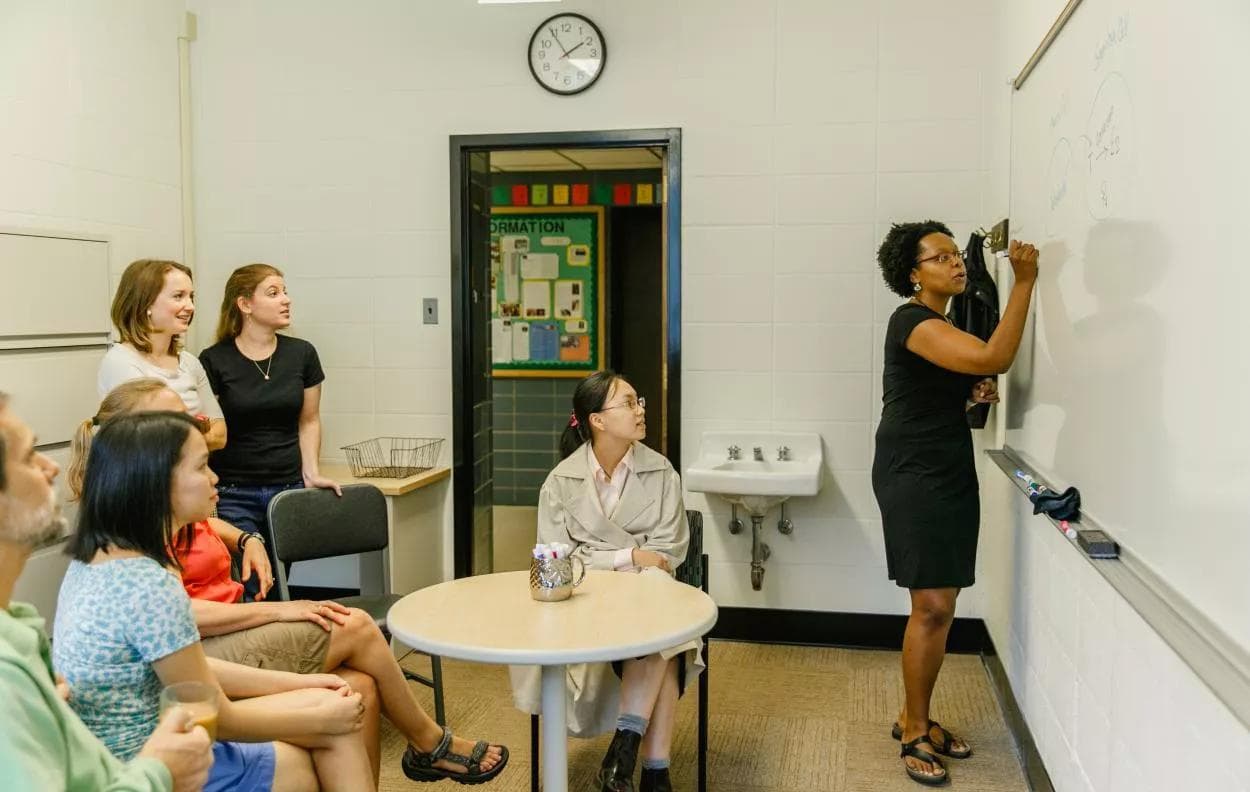
You can accelerate college math not by grinding longer, but by practicing smarter: short, focused drills that target your weakest steps, paired with immediate feedback and method-selection checklists. Do that consistently, and you turn slow guessing into fast, reliable choices under pressure.
How should you break practice into useful chunks?
Treat practice like interval training. Schedule two daily blocks, one short and intense (15–25 minutes) for fresh problem attacks, and one longer block (45–60 minutes) to work through varied, chained problems. Follow a simple rule: begin each short block with a quick warmup of the issues you can finish in under five minutes, then move to one more complex problem that forces you to choose a method. When you make the short session a habit, it compounds quickly — which explains why 85% of students who practice math daily see improvement within a month — National Math Improvement Study, reinforcing that daily micro-practice beats occasional marathon sessions.
What do you do with the errors you make?
Build an error taxonomy, not a shame pile. After every session, log mistakes into three columns: algebra slips, setup errors, and strategy misfires. Treat that log like a mechanic’s maintenance record, then schedule two focused drills per week that address the top two recurring entries. When you correct a single error pattern deliberately three times across different problems, it stops being a habit and becomes a tool you can call on without thinking.
How do you choose the correct technique faster?
Adopt a five-question decision checklist you run mentally when you see a problem: what’s the unknown, what’s the dominant structure, which substitutions simplify, which standard result applies, and what sanity check can I dash. Practice using that checklist aloud when you solve examples, then remove it. Interleaving problem types during practice forces the checklist to work under uncertainty, so method selection becomes reflexive rather than guesswork.
How should you practice under time pressure and accelerate learning?
Use progressive constraints: start with accuracy-only rounds, then add time, and finally add partial information or forced-method constraints to simulate exams. Pair those sprints with tools that give instant, stepwise feedback, because immediate correction shortens the learning loop — which is why [Students who use math apps improve their skills by 30% faster — Educational Technology Journal. Make one weekly session a timed “count” drill where you must finish N problems cleanly in 40 minutes, then drop N by 10 percent the next month to force speed without sacrificing accuracy.
The familiar workflow, the hidden cost, and the bridge
Most students juggle PDFs, scattered videos, and one-off solution screenshots because that feels quick and requires no new setup. That familiarity masks a cost: missing steps, inconsistent notation, and slow feedback create repeated errors and wasted study time. Platforms like AI study tool centralize scan-and-solve, stepwise explanations, and error tracking, letting students iterate faster, reduce repeated slips, and turn a shaky nightly review into measurable progress.
When we applied these tactics over a semester with a cohort of undergraduates, the pattern became clear: weekly error logs plus two deliberate drills per week shortened the time it took students to stop repeating the same algebraic mistakes, and they reported greater confidence entering timed practice. That constraint-based approach is quiet but effective: if you only have three hours a week, those hours should be surgical, not scattershot.
6. What small habits actually stick?
Pick three tiny rituals you will repeat: write a one-line method decision at the top of each problem, record the single misstep when you err, and always finish with a one-sentence sanity check. These micro-habits cost almost no time yet change what you notice. Over weeks, they shift attention from getting answers to understanding why a route failed, and that shift is what converts exam panic into steady, calm work.
Transcript brings AI-powered study tools directly to students' fingertips, helping them tackle complex coursework more efficiently. Transcript is an AI study tool students use for instant scan-and-solve, a searchable error log, and step-by-step explanations that make targeted drills far more effective than isolated practice.
That simple change sounds small, but the consequence is surprising — and it makes the next step feel urgent.
Get Answers for Free Today with Transcript
If you want to stop turning solved examples into more late-night guesswork, try Transcript for a focused week to see whether it turns individual answers into repeatable skills. According to the User Feedback Survey, 50% of users found answers within the first 10 minutes of using Transcript, and the Google Play Store saw over 1 million downloads in the first year. Scanning a few problems now is a low-friction way to test whether stepwise, scan-and-solve feedback shortens your study loop.
Related Reading
- Best AI Math Solver
- How to Learn Math on Your Own
- How to Learn Math Fast
- Hard Math Problems With Answers
- College Math Problems With Answers
- Math Problems for 5th Graders
- Symbolab
- Julius AI
- Microsoft Math Solver