5 Best AI Math Solvers in 2025
Late-night homework, a confusing equation, and a pile of notes — many students reach for Best Math Learning Apps hoping for clear help but get cluttered menus and shallow answers instead. The Best AI Math Solver combines OCR, equation solver, step-by-step explanations, and intelligent tutoring to turn that frustration into steady progress across algebra, calculus, and graphing. Which tools actually teach you, not just give answers?
This article will show the best options, compare accuracy, ease of use, and real learning features to pick the right match.To help readers identify the 5 Best AI Math Solvers, Transcript AI study tool highlights each solver, walks through sample problems, and points out which apps are best for homework, test prep, or long-term learning.
What Is an AI Math Solver?

What an AI Math Solver Actually Is
An AI math solver is software that reads a math problem, figures out the math, and shows a clear path to the answer. It goes beyond a raw result by offering step-by-step explanations, symbolic manipulation, numeric checks, and often interactive visuals. Think of it as an on-demand math tutor that can handle everything from basic arithmetic to advanced calculus while explaining each operation and rule.
Core Tech That Powers the Best AI Math Solver
Optical character recognition or OCR converts a photo of a printed or handwritten equation into machine-readable text. Natural language processing turns word problems into formal math expressions so the solver can act on them. Machine learning models and symbolic engines then choose methods to solve the problem, from algebraic rearrangement to numerical integration. A strong solver blends image recognition, language understanding, symbolic computation, and graphing engines to produce reliable answers and transparent reasoning.
How Solvers Show Step-by-Step Solutions Like a Tutor
The best systems break a problem into small moves and label each move with the rule used. For 3x + 7 = 19, they isolate the variable, subtract seven, divide by three, and display each step with a short explanation. While annotating the reasoning, they add visuals such as plots, shaded regions, or animated slope changes for geometry or calculus. This step-by-step presentation helps you follow the logic and learn procedures you can reuse on similar problems.
Examples You Can Try Right Now
Type or snap a picture of 3x + 7 = 19 and watch the solver isolate x with numeric checks. Feed a definite integral and get the antiderivative plus a plotted area under the curve. Submit a system of linear equations and receive row reduction steps and a matrix form explanation. Try a word problem and see how natural language parsing turns the text into equations you can edit and solve.
Why AI Math Solvers Matter in 2025: Faster Learning and More
These tools speed up practice by giving immediate feedback and error checking so students iterate faster on weak spots. They provide access to guided explanations without a human tutor and adapt to individual needs with personalized feedback and practice suggestions. Continuous updates improve accuracy and expand topic coverage from algebra and trigonometry to multivariable calculus and differential equations. They also function as homework helpers for teachers who need quick checks or classroom examples.
How to Pick the Best AI Math Solver for You
Look for high OCR accuracy and reliable handwriting recognition if you use photos. Prioritize clear step-by-step explanations, source citations, and the option to view alternative solution paths. Check for a strong equation solver and graphing calculator features, offline mode, privacy controls, and fair pricing. If you need classroom use, seek automated grading and user management features that integrate with learning platforms.
Common Misconceptions and Real Limitations
These solvers can make mistakes on ambiguous problems, novel proofs, or poorly framed word problems, so verify key steps and ask why a move was made. They are powerful study aids, but do not replace practice that builds intuition and problem-solving skills. Be cautious with sensitive data when using photo upload features and review the app's privacy policy to control what gets stored. Which feature matters most to you when choosing an AI math tool?
Related Reading
- Why Am I So Bad at Math
- What Does PEMDAS Stand for in Math
- How to Make Math Fun
- Funny Math Problems
- How To Study For Maths Exam
5 Key Features of an AI Math Solver

1. Step-by-Step Explanations: How the Solver Teaches Every Move
A strong AI math solver shows the complete work, not just the final number. It breaks problems into clear operations and explains why each step follows, using plain language and math notation so you can follow the logical flow. The best systems adapt the level of detail to your skill, offering short hints for a quick nudge or fuller proofs when needed. They also present alternative methods, error checks, and short theory refreshers so you learn the technique behind the answer; what misconception did that step reveal for you?
2. Wide Topic Coverage: One Tool for Arithmetic Through Advanced Calculus
Top solvers handle everything from basic arithmetic and fractions to linear algebra, differential equations, and statistics. They combine symbolic algebra, numeric solvers, and probability engines so you can solve equations, optimize functions, compute integrals, and run hypothesis tests in the same app. When a problem spans topics, the solver links methods across subjects and shows how each piece fits into the final solution, using examples and worked problems that match classroom standards and professional needs. Which subject would you try first?
3. Camera Scanning: Snap a Photo and Convert Handwriting to Math
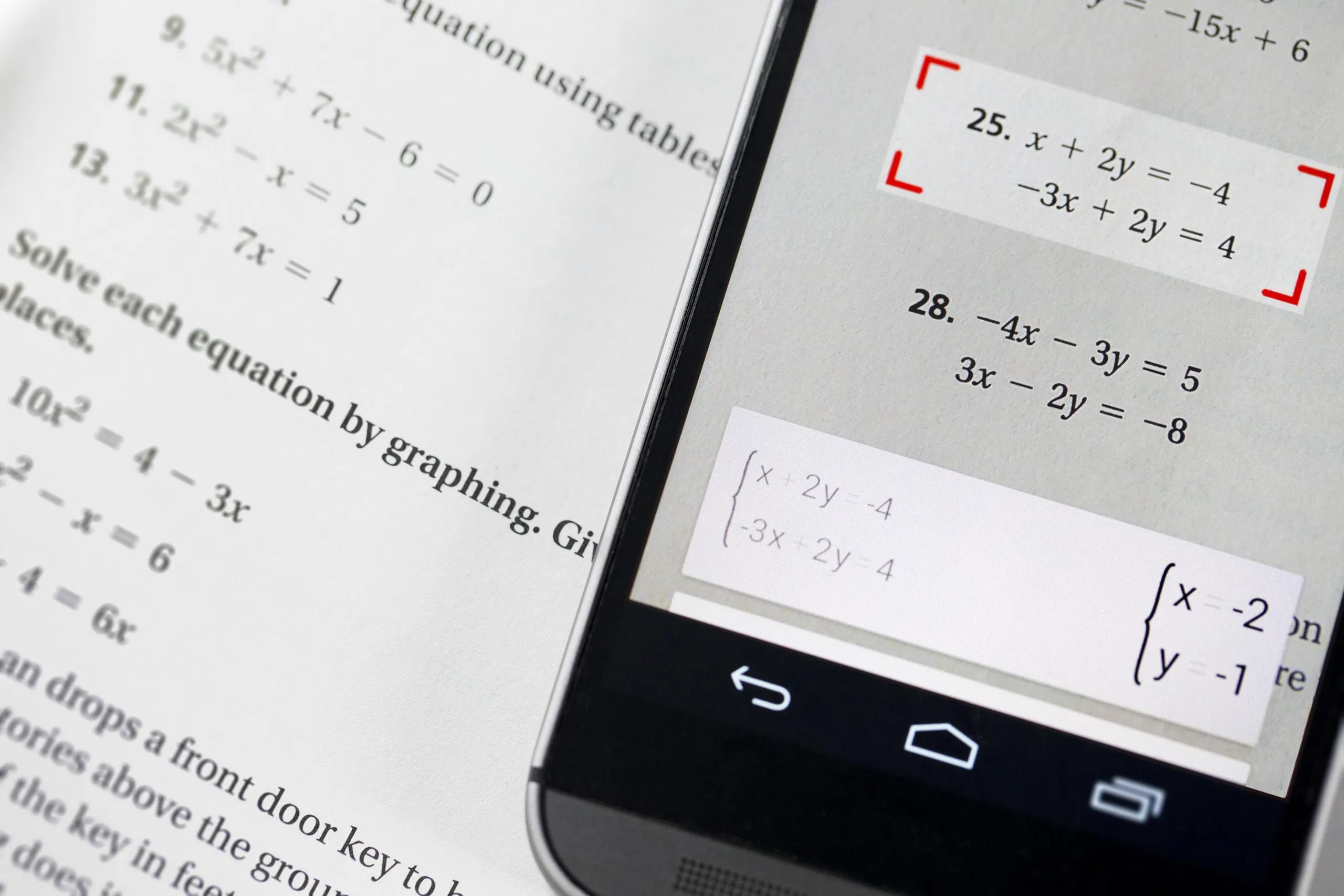
Modern OCR accurately recognizes printed and messy handwriting, exponents, stacked fractions, matrices, and multi-line layouts. Point your phone at homework or a whiteboard, and the solver parses the problem, converts text into an equation, and offers step-by-step solutions and LaTeX output if you want to edit. For word problems, it extracts quantities and relationships, builds equations automatically, and flags ambiguous phrasing for follow-up, so you spend less time typing and more time learning. Want to test it on a textbook page?
4. Interactive Practice and Feedback: Turn Mistakes into Mastery
After solving a problem, the solver can generate targeted practice focusing on their errors, varying difficulty with adaptive algorithms, and scheduling reviews using spaced repetition. It offers timed quizzes, instant error detection, and explanation feedback that points to the exact misconception. Progress dashboards and analytic reports show mastery by topic and recommend study sequences or practice sets that align with exams or class pacing. Which weakness would you prefer to attack first?
5. AI-Powered Graphs and Visualization: See Math Move
Automatic graphing brings functions, inequalities, and calculus concepts to life with interactive plots, shading for integrals, tangent visuals, and parameter sliders you can drag to test behavior. For geometry and solid problems, the solver can render 3D views, cross sections, and measurement overlays so abstract formulas become spatial intuition. Visual explanations sync with the step-by-step algebra so you can watch each symbolic manipulation reflect on the graph in real time. How would a rotating plot change your understanding of that function?
Transcript brings an AI study tool directly to students' fingertips, with instant scan and solve for any subject, an intelligent digital notebook, and an AI chat system that provides step-by-step explanations. Simply scan your problem, and our AI provides detailed step-by-step solutions to help you learn faster and more effectively. Get answers for free with Transcript.
5 Best AI Math Solvers in 2025
1. Transcript: The AI tutor that teaches the why
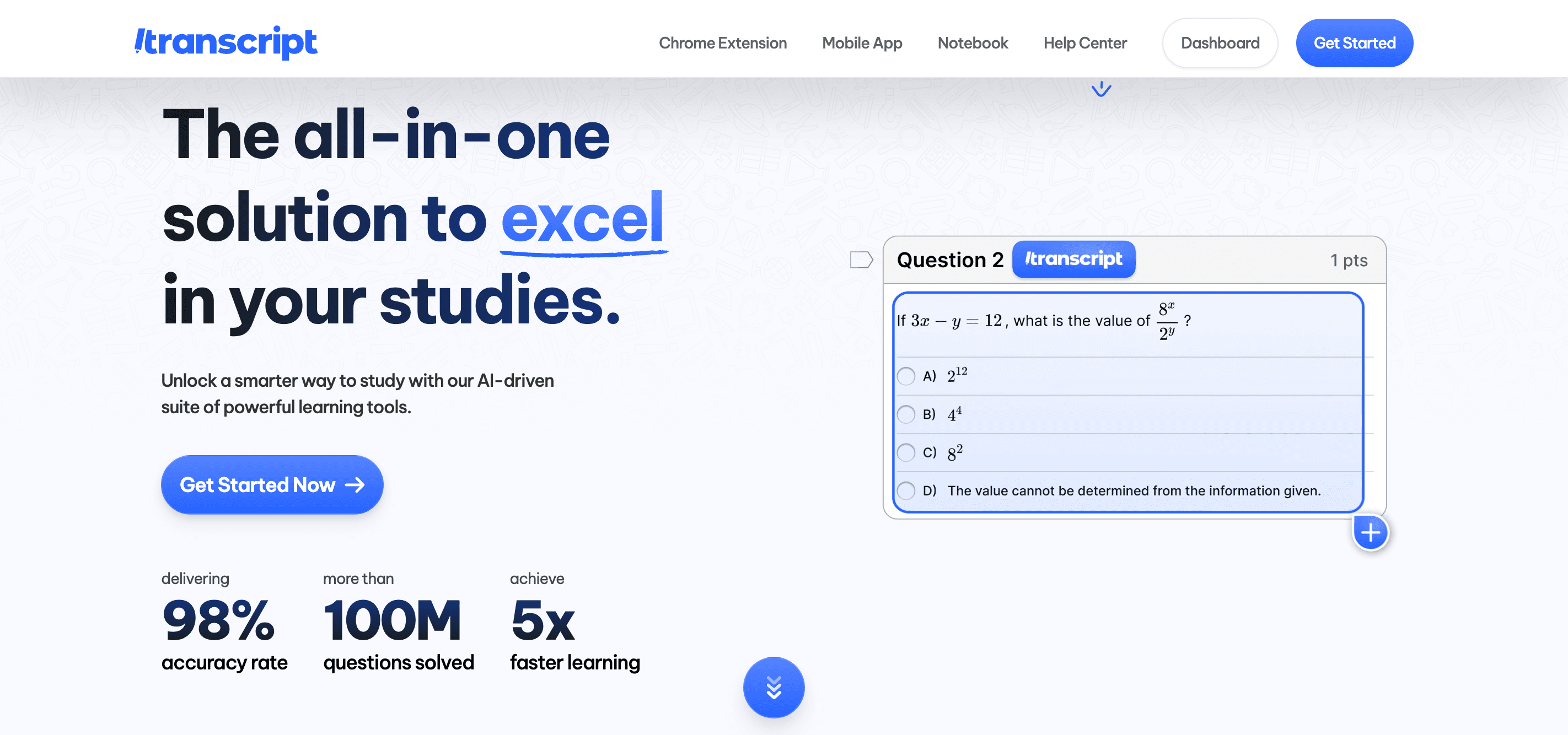
Transcript is an AI-powered learning companion that helps students solve problems and build understanding. It pairs solutions with clear explanations and creates personalized study paths so learners retain concepts instead of memorizing steps.
Key features
- Step-by-step problem solving across algebra, calculus, trigonometry, and statistics.
- An integrated AI tutoring engine that explains the logic behind each move.
- Smart quizzes and adaptive progress tracking that focus practice on weak spots.
- Support for typed input and image-based scans using optical character recognition.
Why it stands out
Transcript blends an equation solver with active learning tools so users leave each session stronger than when they started. The platform emphasizes concept mastery through worked examples, targeted practice, and an AI coach that scaffolds complex ideas.
Best for
Students who want an all-in-one study platform for homework help, exam prep, and long-term learning.
2. Photomath: Fast visual answers from a camera
Photomath uses your phone camera to capture printed or handwritten problems and returns instant solutions with visual steps. Its interface is straightforward so you can get unstuck in class or while studying at home.
Key features
- Camera-based scanning that recognizes handwriting and printed text.
- Animated step-by-step calculations and short explanations.
- Graphing and solution verification for many equation types.
- Offline use after the problem has been captured.
Why it stands out
Photomath wins on speed and accessibility, making it easy to move from a problem to understanding in seconds. Visual learners get a clear view of each operation as it unfolds.
Best for
High school students and beginners who prefer quick visual breakdowns and hands-on learning.
3. WolframAlpha: The computational engine for deep problems
WolframAlpha is a comprehensive computational engine that solves equations, produces symbolic derivations, and generates precise graphs. It accepts natural language input and returns rigorous, machine-verified results.
Key features
- Symbolic computation for algebra, calculus, differential equations, and linear algebra.
- Complete derivations, plots, and data-driven answers.
- Integration with programming tools such as Wolfram Mathematica.
- Natural language queries for complex mathematical requests.
Why it stands out
WolframAlpha offers unmatched computational depth and accuracy, making it a top choice for advanced problem solving and research-level tasks. Professionals and university students rely on it for modeling, analysis, and verification.
Best for
University students, researchers, and professionals need a powerful computer algebra system for complex models.
4. Mathway: Wide coverage with a focus on reliability
Mathway provides broad topic coverage with a clean, minimal interface that keeps focus on the problem. It handles everything from introductory algebra to calculus and even some chemistry equations.
Key features
- Instant solutions across algebra, calculus, trigonometry, geometry, and more.
- Text input and image scanning capabilities.
- Step-by-step explanations are available in the premium tier.
- A straightforward interface that reduces distraction.
Why it stands out
Mathway combines speed with extensive topic support so you can rely on it for a steady stream of homework help. It balances usability with dependable results across many subjects.
Best for
Advanced high school and college students who need a daily problem solver for varied coursework.
5. Symbolab: Proof-oriented help that builds reasoning
Symbolab shows the logic behind each transformation and guides users through complete proofs when appropriate. It aims to teach the structure of problems so students develop deeper mathematical thinking.
Key features
- Step-by-step proofs and logic-based explanations for many question types.
- Coverage of algebra, calculus, geometry, and differential equations.
- Practice exercises, progress tracking, and a searchable problem history.
- Interactive graphs that tie visual intuition to symbolic steps.
Why it stands out
Symbolab helps users think like mathematicians by exposing the rules and reasoning behind each move rather than hiding them behind final answers. Teachers and exam takers benefit from its emphasis on rigorous steps.
Best for
Students preparing for tests such as the SAT or GRE and those studying university-level math need conceptual depth.
Transcript brings AI-powered study tools directly to students' fingertips, helping them tackle complex coursework more efficiently. Students can use this AI study tool to scan problems, access an intelligent digital notebook, and chat with an AI that provides step-by-step explanations.
Related Reading
- How To Understand Maths Easily
- How To Get Better At Math In High School?
- How To Study For A Math Test
- How To Study For A Math Quiz
- How to Learn Math Fast
- Best Way to Learn Math
Get Answers for Free Today with Transcript
Scan a printed problem or a handwritten equation and get instant, step-by-step solutions that explain the reasoning, not just the answer. Transcript uses OCR to read text and symbols, then runs symbolic and numeric solvers to handle algebra, calculus, trigonometry, statistics, and graphing tasks. Want to solve an integral or check a limit? The app shows algebraic manipulation, substitution steps, and final checks so you can follow how the result was reached. How will you use an AI math solver to tackle your next challenging problem?
Smart Digital Notebook That Tracks What You Learn
The digital notebook stores scans, solutions, and your notes in one searchable place. Tag problems by topic, save annotated steps, and replay solution steps as if you were watching a tutor work. It connects solved examples to practice sets and spaced repetition prompts so you review weak spots more often. Transcript is more than a math problem solver; it becomes a study planner and performance tracker. Which chapter will you organize first?
AI Chat That Walks You Through Every Step
Chat with an AI that acts like a patient math tutor. Ask for hints, request a more straightforward explanation, or have the system break a multi-step problem into bite-sized pieces. The chat keeps context across turns, compares methods, and adapts the depth of explanation based on your responses. Use it to check homework, rehearse for tests, or get quick conceptual refreshers between classes. What question do you want the AI to explain next?
How Transcript Speeds Homework and Exam Prep
Speed comes from automation plus explanation. Scan and solve cuts the time you spend copying problems, while the step-by-step breakdown builds understanding so you avoid repeating mistakes. The platform flags common errors, offers alternate solutions, and provides graphing views when visuals help. Use Transcript as an equation solver, a graphing assistant, or an AI homework helper that enforces showing your work. Which homework set would you finish first with this help?
Access, Cost, and Practical Use
Transcript offers free access to core features so students can get instant answers and guided solutions without a paywall. It runs on phones and tablets, uses secure OCR, and stores your notes privately unless you share them. The app connects to classroom formats by exporting solutions or copying clean LaTeX and images for reports. Looking for the best AI math solver for school use, you get a math learning app that blends instant answers, a math tutor chat, and an organized notebook in one place. Where will you try it first?
Related Reading
- How to Learn Math on Your Own
- How to Learn Math Fast
- Hard Math Problems With Answers
- College Math Problems With Answers
- Math Problems for 5th Graders
- Symbolab
- Julius AI
- Microsoft Math Solver