What Does PEMDAS Stand for in Math?
You stare at a homework problem where parentheses, exponents, and a mix of multiplication and subtraction all show up, and the answer suddenly depends on how you enter the expression. In Best Math Learning Apps, a clear rule for the order of operations keeps algebra and arithmetic results consistent and saves time on tests and homework. What rule tells you to do exponents before multiplication, or why multiplication and division share the same priority? This guide explains what PEMDAS stands for in Math and gives clear examples to help readers understand its significance.
To reach that goal, Transcript's Solution, an AI study tool, delivers step-by-step practice, instant feedback, and straightforward explanations so you learn the PEMDAS mnemonic and how to evaluate expressions in algebra and arithmetic.
What Is PEMDAS?

PEMDAS stands for Parentheses, Exponents, Multiplication, Division, Addition, and Subtraction. It describes the order of operations that everyone uses, so an expression like 8 + 2 × 3 has one clear value. Think of it as operator precedence rules that let you evaluate expressions the same way every time. Want a quick test of whether you know it? Ask yourself which operation to do first in 2 + 3 × 4.
P — Parentheses and Grouping Symbols Explained
Do everything inside grouping symbols first, working from the innermost group outward. Grouping includes parentheses ( ), brackets [ ], braces { }, fraction bars where numerator and denominator are each a group, radicals and the expression under them, absolute value bars | |, floor and ceiling symbols, and clear function arguments like sin( ) or log( ). Grouping changes the structure of the expression, so treat it as a single unit when you evaluate other steps.
Why Grouping Changes the Result
Grouping changes the meaning. For example, (2 + 3) × 4 equals 20 while 2 + 3 × 4 equals 14 because the parentheses force addition first. Fraction bars function like big grouping boxes: (2 + 6) ÷ (3 × 2) is not the same as 2 + 6 ÷ 3 × 2. Which expression would you pick to show the difference between grouped and ungrouped operations?
E — Exponents and Roots, Including the Unary Minus
After simplifying groups, evaluate exponents and roots next. That covers integer powers, fractional and negative exponents, and roots like square roots. Scientific notation and powers of ten belong here, too. Watch the unary minus: -3^2 means -(3^2) = -9 because the exponent binds to 3 first. But (-3)^2 equals +9 because the damaging lies inside the grouping, and so the power applies to the whole quantity.
M and D — Multiplication and Division Left to Right
Multiplication and division share one priority level. Read expressions left to right and perform whichever of those two appears first. For example, 12 ÷ 3 × 2 equals eight because you divide the multiplication when scanning left to right. Implied multiplication, such as 3x or 2(5 + 1), counts as multiplication. Note that fraction bars override the left-to-right rule because each side of the bar is grouped.
A and S — Addition and Subtraction Left to Right
Addition and subtraction share the same level and also work left to right. Treat subtraction as adding a negative to reduce sign errors: 10 - 3 + 1 becomes 10 + (-3) + 1. That view makes it easier to combine terms and avoid mistakes when signs change. Try rewriting a subtraction problem as the addition of a negative and see how the signs behave.
Why PEMDAS Exists and What Breaks Without It
Without a standard order of operations, expressions like 6 ÷ 3 × 2 or 10 - 3 + 1 would be ambiguous, and different people could get different answers. The convention enforces a predictable sequence so the value of an expression does not depend on the person who computes it. If you ever see ambiguous notation, add parentheses to capture the intent so everyone computes the same result.
How PEMDAS Lines Up with BODMAS and BIDMAS
Other countries use BODMAS or BIDMAS. Brackets correspond to parentheses or grouping. O or I stands for orders or indices, which equals exponents. DM and AS remain the same, left-to-right to right-to-left rules. These acronyms represent the same order of operations as PEMDAS; the letters just differ by regional preference. Which version have you seen in school materials?
Micro Checklist for Reading Any Expression
- Identify all grouping symbols and simplify inner groups first.
- Compute exponents and roots next.
- Make a left-to-right pass for multiplication and division.
- Make a left-to-right pass for addition and subtraction.
- If intent is unclear, add parentheses to make the order explicit.
Mini Examples That Put the Rules to Work
- Example 1: 8 + 2 × (3^2 - 4) ÷ 2^2
- Grouping: 3^2 = 9, then 9 - 4 = 5 so the expression becomes 8 + 2 × 5 ÷ 2^2
- Exponents: 2^2 = 4 so 8 + 2 × 5 ÷ 4 Multiplication and division left to right: 2 × 5 = 10, then 10 ÷ 4 = 2.5
- Addition: 8 + 2.5 = 10.5
Example 2: -3^2 versus (-3)^2
- -3^2 = -(3^2) = -9 because exponent applies to 3 first
- (-3)^2 = +9 because the negative is inside the grouping, and so the square applies to the whole number
Common Pitfalls and Quick Fixes
Watch implied multiplication next to exponents and negatives. Write explicit parentheses around negative bases when they are raised to powers. When a fraction bar covers several terms, treat the entire numerator and denominator as single groups so you do not mix left-to-right rules across the bar. If a calculator or software gives a surprising result, add parentheses and recompute to match the intended meaning.
Questions to Try Right Now
Which operation do you do first in 5 + 4 ÷ 2 × (1 + 1)?
How would you write (-2) raised to the third power to avoid confusion on a calculator?
Related Reading
How to Solve With PEMDAS (Step-by-Step Guide)
PEMDAS Unpacked: The Core Algorithm for Order of Operations
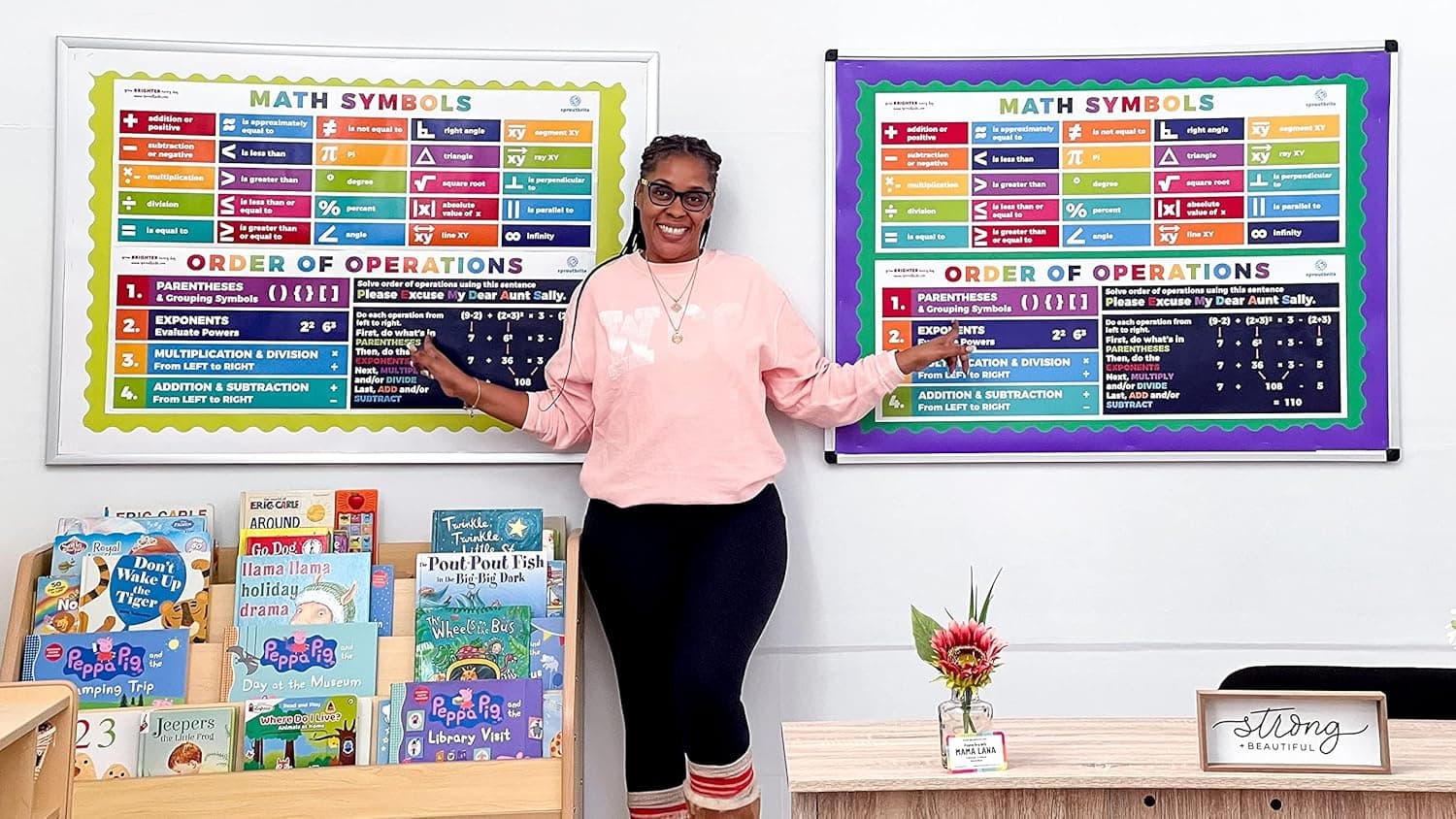
PEMDAS stands for Parentheses Exponents Multiplication Division Addition Subtraction. Use it as an exact sequence for operator precedence when you evaluate expressions. Follow this order every time so your work stays consistent, and anyone reading it can follow the logic.
Core Steps to Apply
- Groupings first: finish the innermost group and work outward. That includes parentheses ( ), brackets [ ], braces { }, fraction bars, radicals sqrt, and absolute value bars | |.
- Treat a long fraction as two separate problems: simplify the numerator, simplify the denominator, then divide.
- Next, evaluate any remaining powers or roots. Watch the unary minus: -3^2 is -(3^2), but (-3)^2 is different.
- Multiplication and division have the same priority. Sweep left to right and perform whichever operation comes first.
- Addition and subtraction share the same priority. Sweep left to right to finish the expression. Make ambiguous expressions explicit with parentheses. If 2/3x can be interpreted in two ways, express it as 2/(3x) or (2/3)·x to ensure clarity.
A Flowchart in Words for Every Line of Work
Box the current inner grouping and finish it before moving outward. That keeps nested tasks simple. If a power or root appears inside the current box, clear it now. That reduces later confusion.
Perform a single left-to-right pass over all multiplication and division operations in that line, rewriting each result as you go. Then do a single left-to-right pass for all addition and subtraction. After each line, perform quick checks to ensure the signs are correct, the parentheses are closed, and the numeric result looks reasonable. That small routine prevents many errors.
Worked Examples: Step by Step with No Shortcuts
Example 1 — Mixing multiplication and division with addition and subtraction
- Evaluate: 12 − 3 × 2 + 5
- Multiply first: 3 × 2 = 6 → 12 − 6 + 5.
- Left to right for addition and subtraction: 12 − 6 = 6, then 6 + 5 = 11.
Answer 11
- Quick check: signs and parentheses are correct.
Example 2 — The classic trap for left to right with × and ÷
- Evaluate: 6 + 4 ÷ 2 × 3
- Do division and multiplication left to right: 4 ÷ 2 = 2, then 2 × 3 = 6 → 6 + 6.
- Add: 6 + 6 = 12.
Answer 12
- Quick check: operator precedence followed, and no parentheses were needed.
Example 3 — Nested brackets, braces, and an outside exponent
- Evaluate: 2{5 + [6 − (4 − 1)^2]} + 3^2
- Innermost parentheses: 4 − 1 = 3. Exponent: 3^2 = 9 → 2{5 + [6 − 9]} + 3^2.
- Brackets: 6 − 9 = −3 → 2{5 + (−3)} + 3^2.
- Braces: 5 + (−3) = 2 → 2(2) + 3^2.
- Multiply: 2 × 2 = 4 → 4 + 3^2.
- Exponent: 3^2 = 9 → 4 + 9 = 13.
Answer 13
- Quick check: each grouping is closed and computed before moving outward.
Example 4 — Fraction bar treated as grouping
- Evaluate: (4 + 8 ÷ 2) / (3 − 1)
- Numerator: 8 ÷ 2 = 4 → 4 + 4 = 8.
- Denominator: 3 − 1 = 2.
- Divide: 8 ÷ 2 = 4.
Answer 4
- Quick check: handle numerator and denominator separately.
Example 5 — Absolute value and radicals
- Evaluate: | −3^2 + 4 | + sqrt(16 ÷ 4)
- Exponent binds to 3: −3^2 = −9. Then −9 + 4 = −5 → | −5 | = 5.
- Inside root: 16 ÷ 4 = 4 → sqrt 4 = 2.
- Sum: 5 + 2 = 7.
Answer 7
- Quick check: unary minus was handled before squaring.
Example 6 — External negative with a power and dividing by a square
- Evaluate: −(2 − 5)^3 ÷ (−3)^2
- Parentheses: 2 − 5 = −3. Cube: (−3)^3 = −27.
- External negative: −(−27) = 27.
- Denominator: (−3)^2 = 9.
- Divide: 27 ÷ 9 = 3.
Answer 3. Quick check: signs of numerator and denominator handled separately.
Example 7 — Ambiguity with implied multiplication
Suppose x = 2. Compare two readings
- Left to right reading: 24 ÷ 3 x → (24 ÷ 3) × 2 = 8 × 2 = 16.
- Grouped denominator: 24 ÷ (3x) = 24 ÷ (3 × 2) = 24 ÷ 6 = 4.
Takeaway
Always write 24 ÷ (3x) or (24 ÷ 3)·x to show the meaning.
Quick check
Add parentheses when in doubt.
Example 8 — Decimals and powers of ten
Evaluate: 3.2 × 10^2 − 4(1.5 + 0.5)
- Exponent: 10^2 = 100 → 3.2 × 100 = 320.
- Parentheses: 1.5 + 0.5 = 2.0 → 4 × 2.0 = 8.
- Subtract: 320 − 8 = 312.
Answer 312
- Quick check: decimal places tracked during multiplication.
Example 9 — Fraction with multiple exponents
Evaluate: ((5 + 1)^2 − 3^2) / 2^3
- Parentheses plus exponent: (5 + 1)^2 = 6^2 = 36.
- 3^2 = 9 → Numerator: 36 − 9 = 27.
- Denominator: 2^3 = 8.
- Divide: 27 ÷ 8 = 3.375 or 27/8.
Answer 27/8 = 3.375
- Quick check: fractional result makes sense compared to the numerator and denominator.
Mini Practice: Try these and check the answers right below
Problem 1: 18 − 3(2 + 4) + 2^3
- Parentheses: 2 + 4 = 6 → 18 − 3(6) + 8.
- Multiply: 3 × 6 = 18 → 18 − 18 + 8.
- Left to right: 18 − 18 = 0, 0 + 8 = 8.
Answer 8
- Quick check: orders and signs correct.
Problem 2: 6 ÷ 2(1 + 2) — write it with parentheses to remove ambiguity
- If you mean 6 ÷ [2(1 + 2)]: (1 + 2) = 3 → 6 ÷ (2 × 3) = 6 ÷ 6 = 1.
- If you mean (6 ÷ 2) × (1 + 2): (6 ÷ 2) = 3, (1 + 2) = 3 → 3 × 3 = 9.
Answer
- Use parentheses to show intent so the result is unambiguous.
Problem 3: |5 − 3^2| + sqrt 9
- 3^2 = 9 → |5 − 9| = |−4| = 4.
- sqrt 9 = 3. Sum 4 + 3 = 7.
Answer 7
- Quick check: absolute value removes the negative sign.
Your Always Right Checklist for Order of Operations
- Finish innermost groupings first, including fraction bars, radicals, and absolute value bars.
- Do exponents and roots next and pay attention to any unary minus signs.
- Sweep multiplication and division left to right in a single pass. Then sweep addition and subtraction left to right.
- Add parentheses whenever an expression could be read more than one way.
End each line with a quick sanity check: estimate the magnitude, verify signs, and confirm all grouping symbols are closed.
Transcript brings AI-powered study tools directly to students' fingertips, serving as a reliable AI study tool for instant scanning and solving, an intelligent digital notebook, and an interactive AI chat that delivers step-by-step explanations. Get answers for free with Transcript.
7 Common PEMDAS Mistakes (and Exactly How to Fix Them)

1. Multiplication vs Division: Why × Does Not Always Come First
The Mistake
Doing every multiplication before any division. For example, someone reads 12 ÷ 3 × 2 and computes 12 ÷ (3 × 2) = 2.
Why Is It Wrong
In the order of operations, multiplication and division share the same priority. You do whichever comes first as you move left to right.
Correct Rule
After group symbols and exponents, perform multiplication and division in one pass from left to right.
Worked Example You Can Copy
12 ÷ 3 × 2 = (12 ÷ 3) × 2 = 4 × 2 = 8. A quick check trick is to draw a faint arrow under the expression and move left to right.
2. Addition vs Subtraction: Do Not Do All Addition First
The Mistake
Doing all additions before any subtractions.
Example
evaluating 10 − 3 + 1 as 10 − (3 + 1) = 6.
Why Is It Wrong
Addition and subtraction are of the same priority, so the correct processing is left to right after the multiply and divide pass.
Correct Rule
After multiplication and division, sweep left to right, performing addition and subtraction in the order they appear.
Worked Example You Can Copy
10 − 3 + 1 = (10 − 3) + 1 = 7 + 1 = 8. A helpful rewrite is 10 + (−3) + 1, and then go left to right.
3. Fraction Bars, Radicals, and Absolute Value Act Like Parentheses
The Mistake
Treating fraction bars, square roots, or absolute value signs as ordinary text and simplifying parts outside their group early.
Why Is It Wrong
A horizontal fraction bar, a radical sign, and absolute value signs group everything inside them. You must finish the work inside that grouping before applying the outer operation.
Correct Rule
Fully simplify the numerator and the denominator separately for a fraction. Thoroughly evaluate the expression under a radical or inside absolute value symbols before taking the root or absolute value.
Worked Example You Can Copy
- Fraction: (2 + 4) / 2 = 6 / 2 = 3. Wrong would be 2 + (4 / 2) = 2 + 2 = 4.
- Radical: sqrt(9 + 7) = sqrt(16) = 4. Do the interior first every time.
4. Negative Numbers and Powers: Where the Minus Lives
The Mistake
Treating −3^2 the same as (−3)^2.
Why Is It Wrong
Exponentiation binds to the base immediately to its right. A leading minus is not part of the base unless you include parentheses.
Correct Rule
−3^2 means −(3^2) = −9. (−3)^2 means the negative is inside the power and equals +9.
Worked Example You Can Copy
−3^2 = −(3^2) = −9. But (−3)^2 = 9. When substituting a negative number for a variable, always put the negative in parentheses before raising to a power.
5. Implied Multiplication Needs Parentheses
The Mistake
Writing expressions like 2/3x and assuming everyone reads them the same way.
Why it is wrong: Without parentheses, the expression is ambiguous. 2/3x can mean 2/(3x) or (2/3) x.
Correct Rule
When an expression can be read two ways, add parentheses to make the grouping explicit.
Worked Example You Can Copy
let x = 2: 2/(3x) = 2/(3·2) = 2/6 = 1/3. (2/3) x = (2/3)·2 = 4/3. Habit: whenever you write a coefficient or a fraction next to a variable, use parentheses to show your intent.
6. Powers Do Not Spread Over Addition
The Mistake
Assuming (a + b)^2 = a^2 + b^2.
Why Is It Wrong
Exponents do not distribute over sums or differences. Squaring a sum creates cross terms.
Correct Rule
Expand (a + b)^2 as a^2 + 2ab + b^2. For subtraction, use a similar expansion or a formula.
Worked Example You Can Copy
(3 + 2)^2 = 5^2 = 25. But 3^2 + 2^2 = 9 + 4 = 13, which is not equal. Continually expand or factor before simplifying powers on sums.
7. Write Every Step: Avoid Sign Slips and Copy Errors
The Mistake
Doing algebra in your head, skipping lines, dropping a minus sign, or miscopying parentheses.
Why Is It Wrong
Small transcription or sign errors break the order of operations and lead to incorrect answers when you think you followed the rules.
Correct Rule and Routine
Write every step on its own line. After you finish, run a quick three-point check: signs, matching parentheses and grouping symbols, and a reasonableness check by estimating or plugging values.
Worked Example You Can Copy
Evaluate 18 − 3(2 + 4) + 2^3.
- Step 1 parentheses: 2 + 4 = 6, so the expression becomes 18 − 3·6 + 8.
- Step 2: multiply: 3·6 = 18, so the expression becomes 18 − 18 + 8.
- Step 3: Add right and subtract: 18 − 18 = 0, then 0 + 8 = 8.
- Practice habit: For your first few problems in a session, write out complete steps until you achieve solid accuracy.
Transcript brings AI-powered study tools directly to students' fingertips, helping them tackle complex coursework more efficiently. Try Transcript as an AI study tool to scan and solve problems, use an intelligent digital notebook, or chat with an AI that gives step-by-step explanations, and get answers for free.
Related Reading
- How To Understand Maths Easily
- How To Get Better At Math In High School?
- How To Study For A Math Test
- How To Study For A Math Quiz
- How to Learn Math Fast
- Best Way to Learn Math
Get Answers for Free Today with Transcript
Transcript brings AI-powered study tools directly to students. Scan a math problem with your phone, and the platform uses instant scanning to solve for any subject, producing a step-by-step solution. An intelligent digital notebook saves your work, organizes problems by topic, and tracks errors so you can target weak spots. The AI chat provides guided, step-by-step explanations and clarifies each operation when you get stuck. Get answers for free with Transcript.
PEMDAS Unpacked: What Each Letter Means and Why It Matters
PEMDAS is a mnemonic that helps you remember the order of operations used to evaluate expressions. It stands for Parentheses, Exponents, Multiplication, Division, Addition, and Subtraction. Parentheses mean do grouped expressions first, including fraction bars and nested brackets. Exponents cover powers and roots. Multiplication and Division share the same level of precedence, so you perform them left to right. Addition and Subtraction also share a level and run left to right. These rules form the basic hierarchy of operations students use to evaluate arithmetic and algebraic expressions.
PEMDAS in Action: Clear Examples You Can Try
Try 3 + 4 × 2. Do multiplication first, so you get 3 + 8 = 11. With parentheses and exponents, try (2 + 3) 2 × 4. First solve the parentheses 2 + 3 = 5, then the exponent 5 2 = 25, then multiply 25 × 4 = 100. For the left-to-right point, compute 20 ÷ 5 × 2. Divide 20 by 5, then multiply the result by 2. Work through a few expressions by hand and then check each step with an AI tutor.
Common Pitfalls Students Run Into Using PEMDAS
Confusion often comes from treating multiplication as always higher than division or treating addition as consistently higher than subtraction. These pairs share precedence and must be applied left to right. Students also forget that a fraction bar or parentheses act as a grouping symbol, which forces work inside them first. Another error is ignoring implicit multiplication, such as 2(3 + 4), which still requires you to do the parentheses before multiplying. When negative exponents or roots appear, handle the exponent operation before proceeding to multiplication or division.
PEMDAS versus BEDMAS and BODMAS: Same Rules, Different Words
Different countries use different mnemonics. BEDMAS uses Brackets and Orders, while BODMAS uses Brackets and Orders as well. Brackets equal Parentheses. Orders refer to exponents and roots. All of these follow the same underlying order of operations and the same left-to-right rule for pairs that share a level. If you see a different mnemonic, translate the terms and follow the same evaluation strategy.
How Transcript Helps You Master PEMDAS, Step by Step
Want a tool that shows each operation and why it comes next? Transcript scans problems and produces a step-by-step breakdown that highlights parentheses, exponents, and the left-to-right application of multiplication, division, and addition subtraction. Use the AI chat to ask why one step came before another, or to request extra practice that focuses on division versus multiplication. The intelligent notebook keeps your solved problems so you can review common mistakes and practice targeted drills. Get answers for free with Transcript.
Related Reading
- Best AI Math Solver
- How to Learn Math on Your Own
- How to Learn Math Fast
- Hard Math Problems With Answers
- College Math Problems With Answers
- Math Problems for 5th Graders
- Symbolab
- Julius AI
- Microsoft Math Solver